RVP Annual Seminars

About RVP

Regional Network

Publications

Annual Seminars

International Conferences

Board Members

Associate Membership

Newsletters

Support

Contact


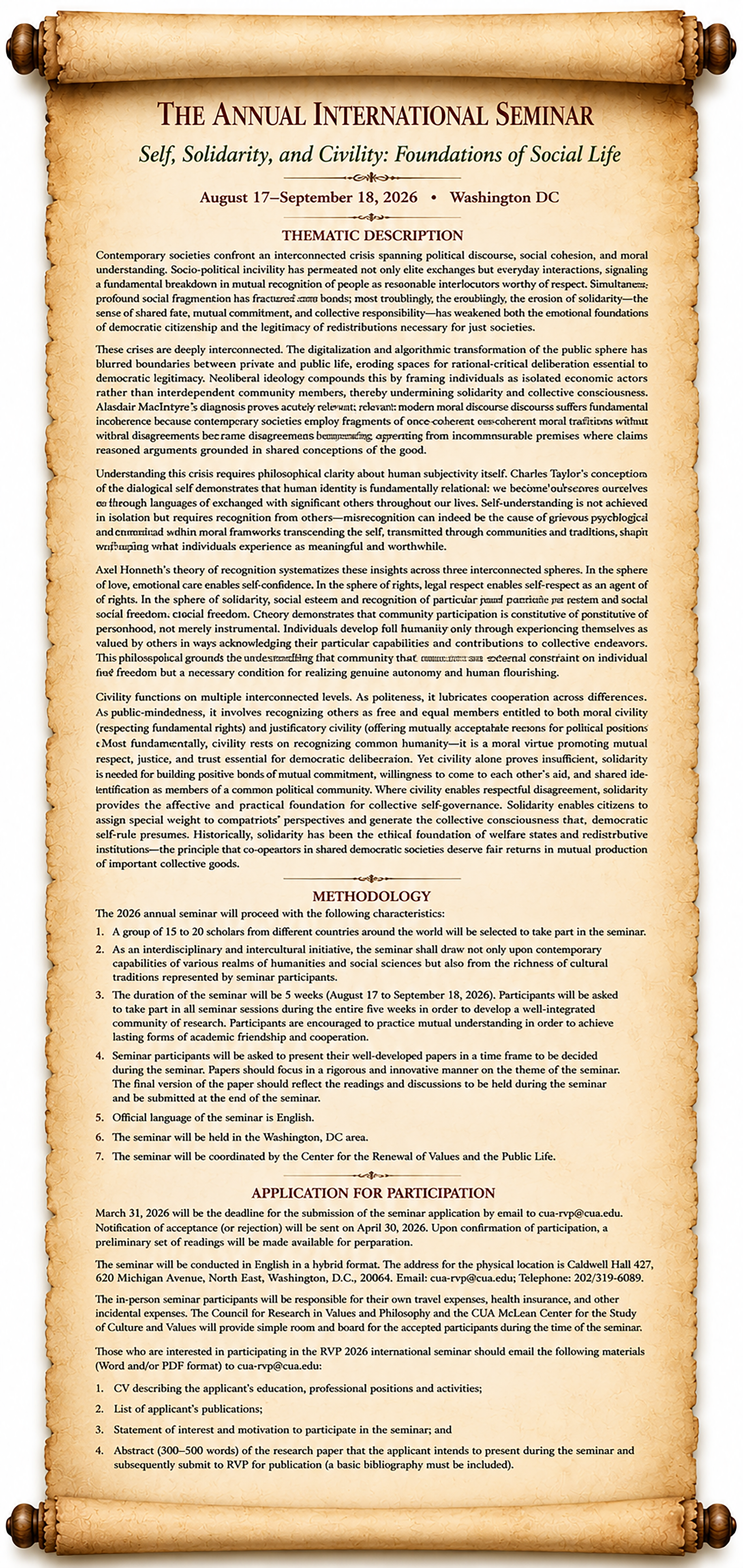
THE  ANNUAL INTERNATIONAL SEMINAR    

Self, Solidarity, and Civility: Foundations of Social Life


August 17-September 18, 2026                                      Washington DC


Thematic Description

Contemporary societies confront an interconnected crisis spanning political discourse, social cohesion, and moral understanding. Socio-political incivility has permeated not only elite exchanges but everyday interactions, signaling a fundamental breakdown in mutual recognition of people as reasonable interlocutors worthy of respect. Simultaneously, profound social fragmentation has fractured community bonds; most troublingly, the erosion of solidarity—the sense of shared fate, mutual commitment, and collective responsibility—has weakened both the emotional foundations of democratic citizenship and the legitimacy of redistributive institutions necessary for just societies.

These crises are deeply interconnected. The digitalization and algorithmic transformation of the public sphere has blurred boundaries between private and public life, eroding spaces for rational-critical deliberation essential to democratic legitimacy. Neoliberal ideology compounds this by framing individuals as isolated economic actors rather than interdependent community members, thereby undermining solidarity and collective consciousness. Alasdair MacIntyre's diagnosis proves acutely relevant: modern moral discourse suffers fundamental incoherence because contemporary societies employ fragments of once-coherent moral traditions without the frameworks that made them intelligible. Consequently, moral disagreements become interminable, operating from incommensurable premises where claims function as personal preferences rather than reasoned arguments grounded in shared conceptions of the good.

Understanding this crisis requires philosophical clarity about human subjectivity itself. Charles Taylor's conception of the dialogical self demonstrates that human identity is fundamentally relational: we become ourselves through languages of expression exchanged with significant others throughout our lives. Self-understanding is not achieved in isolation but requires recognition from others—misrecognition can indeed be the cause of grievous psychological and moral harm. Taylor's concept of “moral sources” reveals that individuals orient themselves within moral frameworks transcending the self, transmitted through communities and traditions, shaping what individuals experience as meaningful and worthwhile.

Axel Honneth's theory of recognition systematizes these insights across three interconnected spheres. In the sphere of love, emotional care enables self-confidence. In the sphere of rights, legal respect enables self-respect as an agent of rights. In the sphere of solidarity, social esteem and recognition of particular contributions to shared projects enable self-esteem and social freedom. Crucially, recognition theory demonstrates that community participation is constitutive of personhood, not merely instrumental. Individuals develop full humanity only through experiencing themselves as valued by others in ways acknowledging their particular capabilities and contributions to collective endeavors. This philosophical anthropology grounds the understanding that community is not an external constraint on individual freedom but a necessary condition for realizing genuine autonomy and human flourishing.

Civility functions on multiple interconnected levels. As politeness, it lubricates cooperation across differences. As public-mindedness, it involves recognizing others as free and equal members entitled to both moral civility (respecting fundamental rights) and justificatory civility (offering mutually acceptable reasons for political positions). Most fundamentally, civility rests on recognizing common humanity—it is a moral virtue promoting mutual respect, justice, and trust essential for democratic deliberation. Yet civility alone proves insufficient, solidarity is needed for building positive bonds of mutual commitment, willingness to come to each other’s aid, and shared identification as members of a common political community. Where civility enables respectful disagreement, solidarity provides the affective and practical foundation for collective self-governance. Solidarity enables citizens to assign special weight to compatriots' perspectives and generate the collective consciousness that democratic self-rule presumes. Historically, solidarity has been the ethical foundation of welfare states and redistributive institutions—the principle that co-operators in shared democratic societies deserve fair returns in mutual production of important collective goods.

Methodology


The 2026 annual seminar will proceed with the following characteristics:


1. A group of 15 to 20 scholars from different countries around the world will be selected to take part in the seminar. 


2. As an interdisciplinary and intercultural initiative, the seminar shall draw not only upon contemporary capabilities of various realms of humanities and social sciences but also from the richness of cultural traditions represented by seminar participants.


3. The duration of the seminar will be 5 weeks (August 17 to September 18, 2026). Participants will be asked to take part in all seminar sessions during the entire five weeks in order to develop a well-integrated community of research. Participants are encouraged to practice mutual understanding in order to achieve lasting forms of academic friendship and cooperation.


4. Seminar participants will be asked to present their well-developed papers in a time frame to be decided during the seminar. Papers should focus in a rigorous and innovative manner on the theme of the seminar. The final version of the paper should reflect the readings and discussions to be held during the seminar in order to be considered for publication.


Application for Participation 


March 31, 2026 will be the deadline for the submission of the seminar application by email to [cua-rvp@cua.edu]. Notification of acceptance (or rejection) will be sent on April 30, 2026. Upon confirmation of participation, a preliminary set of readings will be made available for preparation.


The seminar will be conducted in English in a hybrid format. The address for the physical location is Caldwell Hall 427, 620 Michigan Avenue, North East, Washington, D.C., 20064. Email: cua-rvp@cua.edu; Telephone: 202/319-6089. 


The in-person seminar participants will be responsible for their own travel expenses, health insurance, and other incidental expenses. The Council for Research in Values and Philosophy and the CUA McLean Center for the Study of Culture and Values will provide simple room and board for the accepted participants during the time of the seminar.


Those who are interested in participating in the RVP 2026 international seminar should email the following materials (Word and/or PDF format) to cua-rvp@cua.edu:


1. CV describing the applicant’s education, professional positions and activities;

2. List of applicant’s publications;

3. Statement of interest and motivation to participate in the seminar; and

4. Abstract (300-500 words) of the research paper that the applicant intends to present during the seminar and subsequently submit to RVP for publication (a basic bibliography must be included).


(all the materials on this website are copyrighted © by the Council for Research in Values and Philosophy)

Caldwell Hall 427, 620 Michigan Avenue, NE, Washington, DC, 20064; Telepone: 202/319-6089; Email: cua-rvp@cua.edu; Website: www.crvp.org